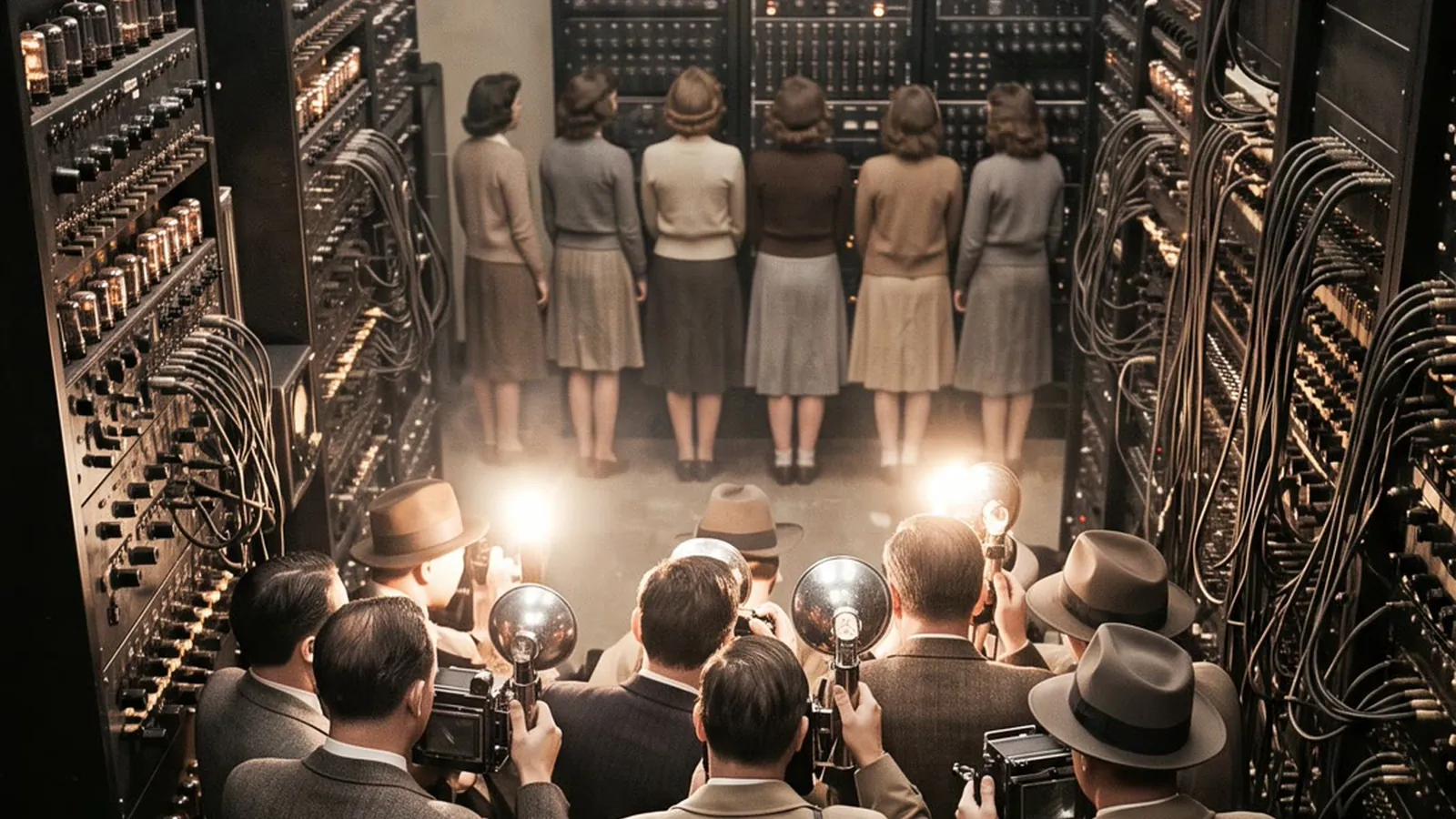
The 60-Year Overnight Success
ChatGPT looked overnight. Its roots: 1958.

Context
Code Stories is a picture-led history/essay Short (2:50) on @AI.JoinDev. No diagrams, phone or terminal: documentary art (no likenesses of real people; names appear as text only), archive plates, clippings, numbers with sources. This episode follows one idea, the artificial neural network, from Rosenblatt's 1958 perceptron to ChatGPT in 2022. Facts: specs/sixty-year-overnight-success.facts.md (F-numbers below); review: specs/sixty-year-overnight-success.review.md.
Trade-offs
- History is simplified to one thread (neural networks); symbolic AI, SVMs and many contributors are left out.
- Backprop had earlier inventors (Linnainmaa 1970, Werbos 1974); the video says "made famous", not "invented".
- How much Perceptrons caused the first winter is debated; the video only says "neural networks fell out of favour".
- The 100 M users figure is an analyst estimate (UBS, monthly active users, January 2023), not an OpenAI number.
- AlexNet's 15.3% was an ensemble with extra training data (16.4% on supplied data only); shown as a caveat.
Numbers worth knowing
- 50 trials: the 1958 IBM 704 demo learned left vs right (Cornell / NYT) — F2
- 400 photocells (20×20) in the Mark I Perceptron's eye — F4
- ~10% of US cheques read by the LeNet-based system, est. 2001 (~20 M a day) — F11
- up to ~70× faster on GPUs than a dual-core CPU (Raina et al., ICML 2009, one study) — F14
- 15.3% vs 26.2% top-5 error, ILSVRC 2012 — F15
- 8 authors, Transformer paper, 12 June 2017 — F16
- est. 100 M monthly active users by January 2023, two months after ChatGPT's 30 Nov 2022 launch (UBS) — F18
- 64 years, 1958 → 2022 — F20