AI news · 10 stories

AI news for Oct 16, 2026

Figma launches Specs to share design context with AI agents · Amazon introduces Bee Frontier and Bee Eclipse personal AI devices · States sue OpenAI over alleged ChatGPT consumer harms

News card: Figma launches Specs to share design context with AI agents
Figma

Figma launches Specs to share design context with AI agents

Figma is rolling out Specs in open beta on paid plans, placing collaborative Markdown documents beside designs on its canvas. Coding agents can access specs and linked design context through Figma’s MCP server, helping carry product intent into implementation.

Read at Figma


News card: Amazon introduces Bee Frontier and Bee Eclipse personal AI devices
Amazon

Amazon introduces Bee Frontier and Bee Eclipse personal AI devices

Amazon introduced the Bee Frontier wearable and Bee Eclipse magnetic phone attachment to turn conversations into summaries and reminders. Frontier is available now and Eclipse is coming soon, with optional Alexa+ and Amazon.com connections extending how those memories can be used.

Read at Amazon
News card: States sue OpenAI over alleged ChatGPT consumer harms
Associated Press

States sue OpenAI over alleged ChatGPT consumer harms

At least eight US states sued OpenAI, alleging ChatGPT harms children and deceives adults in violation of consumer protection laws. The cases put chatbot safety claims and protections for vulnerable users under further legal scrutiny; the claims are allegations, not court findings.

Read at Associated Press
News card: Anthropic reportedly turns cash-flow positive
Axios

Anthropic reportedly turns cash-flow positive

Axios reports that Anthropic disclosed positive cash flow as investors questioned the sustainability of heavy AI spending. The report points to its focus on coding and business customers, while noting that revenue growth has slowed from the previous quarter’s pace.

Read at Axios
News card: Grok Voice 3.0 launches through the Voice Agent API
SpaceXSI

Grok Voice 3.0 launches through the Voice Agent API

Grok Voice 3.0 launched on October 14 through the Voice Agent API at the same price as its predecessor. The company says the model powers customer-support conversations at Starlink, illustrating the move from voice demos to operational service agents.

Read at SpaceXSI
News card: Modal raises $750 million to expand AI infrastructure
Modal

Modal raises $750 million to expand AI infrastructure

Modal announced a $750 million Series D led by Accel at a $15.75 billion post-money valuation. The company says it has crossed $1 billion in annualized run rate as demand grows for infrastructure supporting inference, training and agent sandboxes.

Read at Modal
News card: METR proposes public assessments of internal AI control risks
METR

METR proposes public assessments of internal AI control risks

METR proposed independent assessments of frontier labs’ internal AI alignment, control systems and research acceleration, with public reports and disclosure of access limits. It stresses that these voluntary exercises would provide evidence rather than a safety guarantee or formal oversight.

Read at METR
News card: NVIDIA introduces cuPotential for atomic-scale AI simulation
NVIDIA

NVIDIA introduces cuPotential for atomic-scale AI simulation

NVIDIA introduced cuPotential, a CUDA-X library that developers can use to equip AI agents with tools for simulating atomic and molecular interactions. The release supports a broader semiconductor-industry effort to apply accelerated simulation and AI across chip design and manufacturing.

Read at NVIDIA
News card: TRACER study targets prompt injection across input channels
arXiv

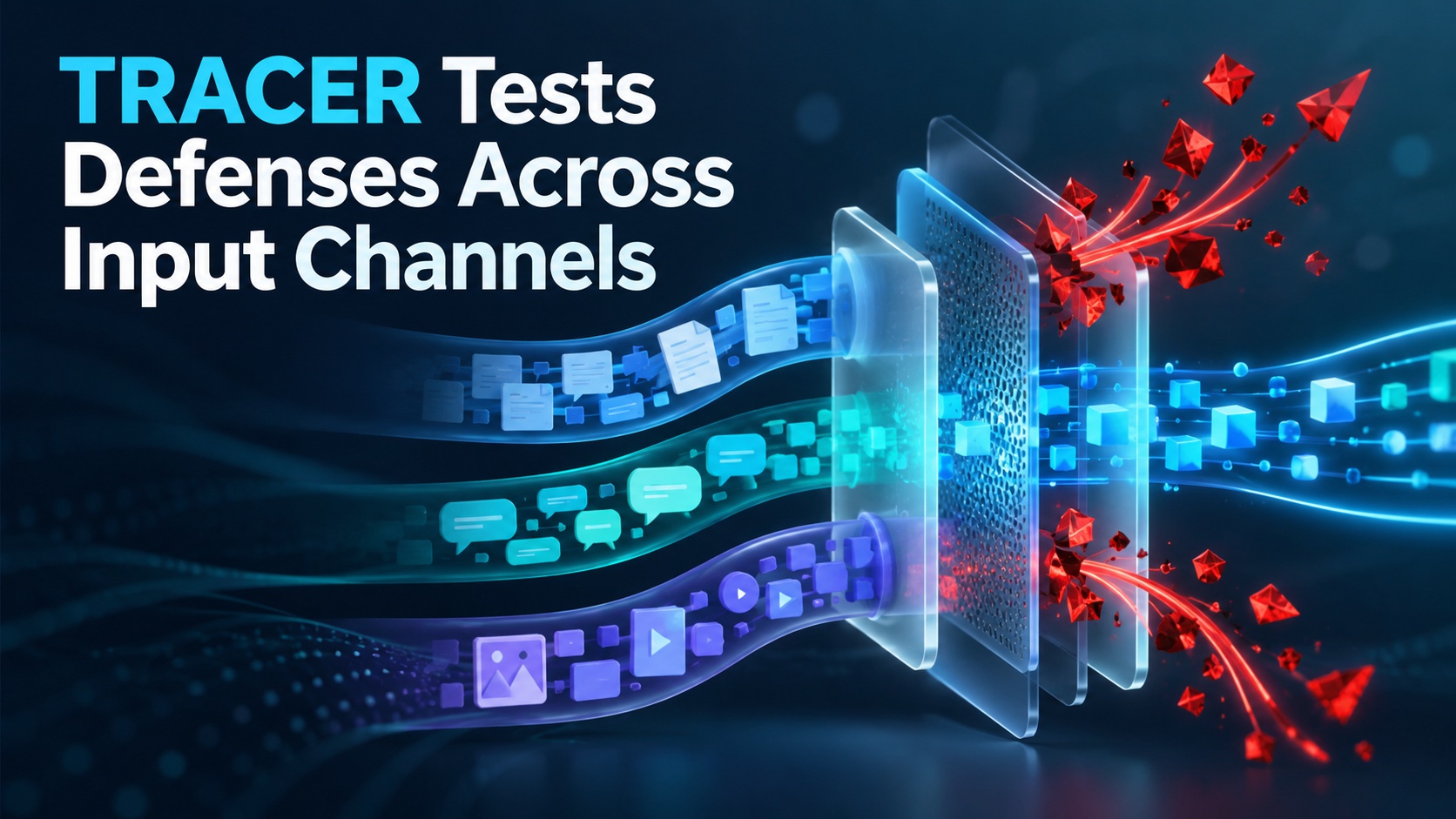
TRACER study targets prompt injection across input channels

Researchers introduced TRACER, a training method that exposes models to attacks delivered through different input channels and regularizes their reasoning. Tests on Qwen models and math tasks suggest channel-aware training can reduce indirect prompt-injection success, with results limited to the evaluated settings.

Read at arXiv
News card: Researchers propose semantic reconstruction for jailbreak evaluation
arXiv

Researchers propose semantic reconstruction for jailbreak evaluation

A new preprint proposes evaluating jailbreak responses by reconstructing the request they actually answer and comparing it with alternatives. The method reduced false positives and disagreement among tested LLM judges, while accepting that some successful attacks may be missed.

Read at arXiv

Get the next episode first

Shorts and deep dives on AI system design land on @AI.JoinDev first. Subscribe, or follow the RSS feed.